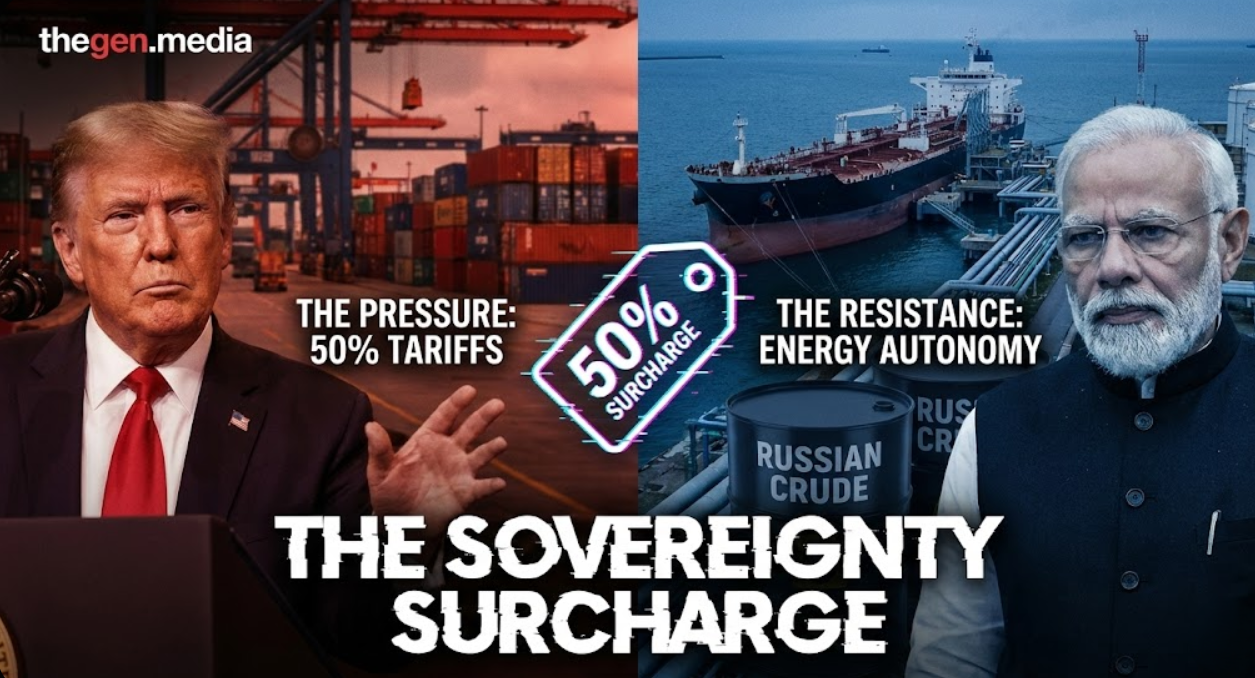
On January 6, the US President boasted that Prime Minister Modi is "not happy" with him. The reason? A punishing economic tax designed to break New Delhi’s independent foreign policy.
Washington D.C. | January 8, 2026
If there were any doubts that the United States is weaponizing trade to dictate the foreign policy of sovereign nations, President Trump erased them on Tuesday.
Speaking at the House GOP Member Retreat on January 6, Trump offered a candid—and chilling—assessment of his relationship with Indian Prime Minister Narendra Modi. He did not speak of shared democratic values or strategic partnership. He spoke of coercion.
"I have a very good relationship with him [Modi], but he is not that happy with me... He is not that happy because they are paying a lot of tariffs now." — President Donald Trump, Jan 6, 2026
The "unhappiness" Trump referred to is a crushing 50% tariff regime currently imposed on Indian goods entering the US, a penalty explicitly linked to India’s refusal to stop buying Russian oil.
The "Russian Oil" Penalty
For decades, India has guarded its "Strategic Autonomy"—the right to make decisions based on Indian interests, not foreign pressure. That autonomy is now being taxed at 50%.
The administration has implemented a two-tier tariff structure on New Delhi:
The "Compliance" Tax Structure
-
The Base Tariff: A standard reciprocal levy applied to all trade partners.
-
The "Sovereignty Surcharge": An additional 25% penalty specifically tied to India’s energy purchases from Moscow.
-
The Result: While Trump claims India has "substantially reduced" Russian imports to make him happy, data shows Russian oil still accounts for 34% of India's total imports.
The reality is that India is choosing to absorb the economic pain rather than yield its sovereignty over energy security.
The Venezuelan Warning: "Controlled By Me"
Why is this tariff battle existential for India? One only has to look at the events of this week in Venezuela to see the alternative.
The user’s observation regarding Venezuela is backed by cold, hard data. While the official US narrative is the "restoration of democracy" following the removal of Nicolás Maduro, the financial reality is a corporate seizure of sovereign assets.
On the same day he discussed Modi (Jan 6), Trump made a separate, startling admission regarding Venezuela’s oil wealth. He didn't promise that oil revenues would go to build schools in Caracas.
"That money will be controlled by me... until we know it won't be stolen again." — Regarding Venezuelan Oil Revenue
The democratic opposition in Venezuela has been sidelined in favor of a US-managed oil extraction operation. The lesson for the Global South is clear: Sovereignty is the only shield against becoming a vassal state.
The Sovereignty Trap
The pressure on India is not an isolated trade dispute; it is part of a doctrine where "allies" are expected to be compliant customers.
-
If you are Venezuela: The US removes your leader and takes direct control of your oil revenue.
-
If you are India: The US keeps your leader but taxes your economy until you buy their oil instead of Russia’s.
It is worth noting that while pressuring India to stop buying Russian crude, US crude exports to India have surged by 92% in the last year. The "moral" stance against Russian oil conveniently doubles as a market-capture strategy for American oil.
Conclusion
As India assumes the BRICS presidency for 2026, the stakes could not be higher. The 50% tariff is not just a tax on textiles or gems; it is the price tag for an independent foreign policy.
Trump’s statement that Modi is "not happy" is perhaps the ultimate compliment to Indian diplomacy. It means India hasn't folded yet. In a world where Venezuelan oil revenue is "controlled by" the US President, being "unhappy" but sovereign is a luxury few nations can afford.