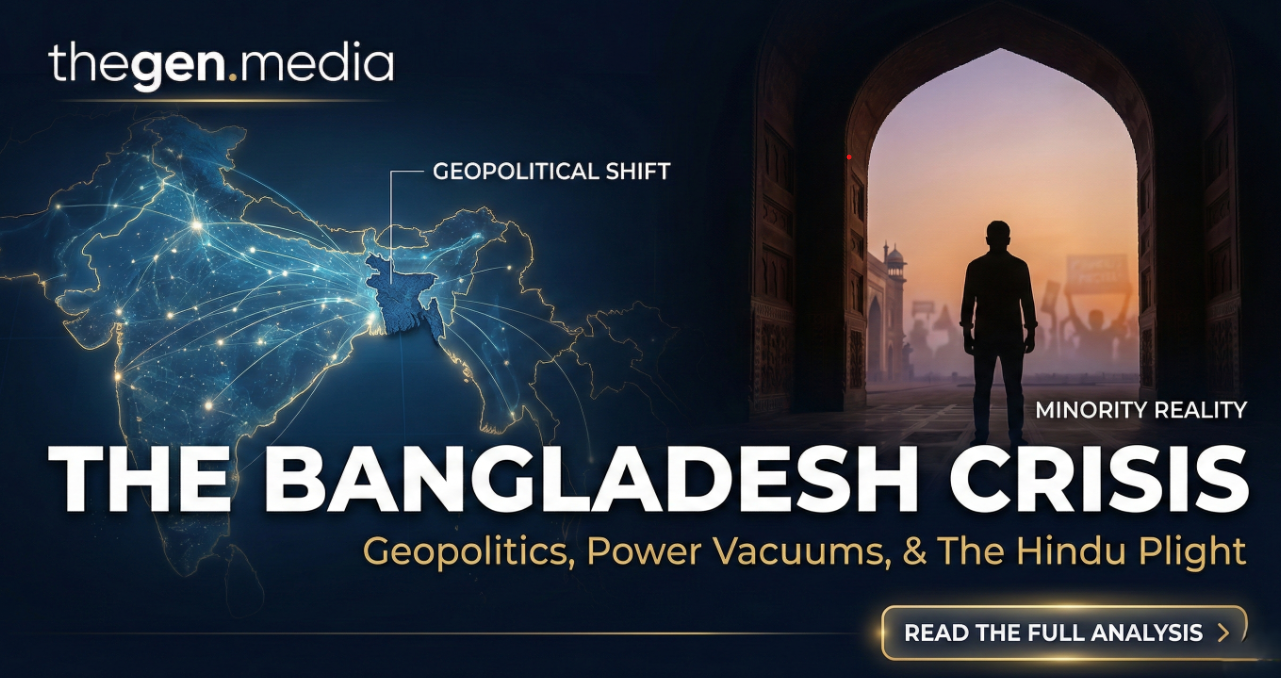
The 'Second Independence' Betrayed: Bangladesh’s Descent into Anarchy
It has been nearly eighteen months since the "July Revolution" culminated in the storming of the Ganabhaban and the ouster of Sheikh Hasina on August 5, 2024. The streets of Dhaka were alive then with the euphoria of a "Second Independence." But as we settle into 2026, that optimism feels like a distant memory, replaced by a grim reality that few in the interim government are willing to admit: the revolution has been hijacked.
What was promised as a transition to democracy has dissolved into a protracted season of anarchy. And at the bleeding edge of this collapse is Bangladesh’s Hindu minority. With general elections now scheduled for February 12, 2026, the community is no longer just facing discrimination; they are facing a systematic campaign of erasure designed to liquidate a historic "vote bank" before a single ballot is cast.
The Sovereignty Gap
The fall of the Awami League was always going to leave a vacuum, but few predicted the absolute paralysis that would follow. The interim government, led by Nobel laureate Muhammad Yunus, was tasked with guiding the nation to polls. Instead, it has presided over a total breakdown of the state’s monopoly on violence.
The police force and local administration have effectively abdicated their duties. In this "sovereignty gap," radical Islamist factions—once suppressed under Hasina’s heavy boot—have re-emerged not just as political players, but as the new arbiters of street justice. For the Hindu community, the political transition has morphed into collective punishment. They are being targeted not merely as religious "others," but as convenient proxies for the deposed regime.
From Looting to Liquidation
The nature of the violence has shifted disturbingly over the last year. In late 2024, we saw opportunistic vandalism—temples damaged, shops looted. But reports from late 2025 and the first week of 2026 indicate a tactical shift toward lethal, targeted violence.
The lynching of Dipu Chandra Das in Mymensingh last month stands as a horrific testament to this new normal. Accused of blasphemy—a charge that has become the ultimate weapon in local feuds—Das was beaten to death and his body set on fire by a mob. Subsequent investigations by the Rapid Action Battalion (RAB) found zero evidence of the alleged crime, but the truth is irrelevant when the goal is terror.
This was not an anomaly. Just days ago, on January 3, 2026, Khokon Chandra Das, a Hindu businessman in Shariatpur, succumbed to injuries after being hacked with sharp weapons and set on fire. In Jashore, Rana Pratap, a journalist, was shot dead. These are not random acts of banditry; they are message-killings designed to instill panic and prompt an exodus before the February vote.
The Mainstreaming of Hate
Perhaps more dangerous than the physical violence is the psychological warfare being waged in plain sight. The derogatory slur "Malaun"—once relegated to the fringes—has re-entered the mainstream political lexicon.
Digital influencers and Islamist groups are actively propagating a narrative that equates "Hindu" with "Anti-State." By framing the minority community as agents of an Indian conspiracy, they successfully silence moderate Muslim voices who might otherwise intervene. Worse, a culture of denialism has taken root among the new political elite in Dhaka. When victims cry out, they are gaslit—accused of fabricating stories to malign Bangladesh’s international image.
The View from New Delhi
For India, this is a diplomatic nightmare come to life. The rise of virulent anti-India sentiment in Dhaka has severed traditional backchannels. New Delhi is now staring at a hostile neighbor and the terrifying prospect of a refugee crisis bleeding into West Bengal, Assam, and Meghalaya. The government’s inability to effectively protect the minority population next door highlights the painful limits of soft power when faced with raw majoritarian aggression.
The Precipice
As we approach the February 12 elections, the crisis in Bangladesh can no longer be dismissed as "post-revolutionary turbulence." It is a fundamental test of the region’s secular fabric. The Hindu community is caught between a state that cannot protect them and a radicalized mob that refuses to accept them.
Unless the interim government can reassert control and dismantle this machinery of hate, the upcoming election will be a farce, and South Asia may witness the beginning of a tragic, irreversible demographic shift. The "Second Independence" promised freedom; for millions, it has delivered only fear.