The Caracas Acquisition /* --- MODERN RESET & VARIABLES --- */ :root { --font-body: -apple-system, BlinkMacSystemFont, "Segoe UI", Roboto, Oxygen, Ubuntu, Cantarell, "Open Sans", "Helvetica Neue", sans-serif; --font-heading: -apple-system, BlinkMacSystemFont, "Segoe UI", Roboto, sans-serif; /* Light Mode Colors (High Contrast) */ --bg-color: #ffffff; --text-main: #111111; /* Almost black for sharpness */ --text-muted: #555555; /* Dark grey for metadata */ --accent-color: #d32f2f; /* News Red */ --card-bg: #f4f6f8; /* Light grey-blue tint */ --border-color: #e0e0e0; } /* Dark Mode Colors (Soft on eyes) */ @media (prefers-color-scheme: dark) { :root { --bg-color: #121212; --text-main: #eeeeee; /* Off-white */ --text-muted: #b0b0b0; --accent-color: #ff5252; /* Brighter red */ --card-bg: #1e1e1e; --border-color: #333333; } } /* --- TYPOGRAPHY & LAYOUT --- */ body { background-color: var(--bg-color); color: var(--text-main); font-family: var(--font-body); font-size: 18px; /* Larger base size for readability */ line-height: 1.7; /* Spacious line height */ margin: 0; padding: 40px 20px; } article { max-width: 680px; /* Optimal line length for reading */ margin: 0 auto; } /* --- HEADINGS --- */ h1 { font-family: var(--font-heading); font-weight: 800; font-size: 2.5rem; line-height: 1.2; margin-bottom: 0.5rem; letter-spacing: -0.02em; } .subtitle { font-size: 1.3rem; color: var(--text-muted); font-weight: 400; margin-bottom: 1.5rem; line-height: 1.4; } .meta-line { font-family: monospace; font-size: 0.9rem; color: var(--accent-color); text-transform: uppercase; letter-spacing: 0.05em; font-weight: 700; border-bottom: 1px solid var(--border-color); padding-bottom: 15px; margin-bottom: 30px; display: block; } h3 { font-size: 1.6rem; margin-top: 3rem; margin-bottom: 1rem; font-weight: 700; letter-spacing: -0.01em; } /* --- BODY ELEMENTS --- */ p { margin-bottom: 1.5rem; } strong { font-weight: 700; color: var(--text-main); } /* --- FEATURED BOX --- */ .insight-card { background-color: var(--card-bg); border-left: 5px solid var(--accent-color); padding: 2rem; margin: 2.5rem 0; border-radius: 0 8px 8px 0; } .insight-card h4 { margin: 0 0 0.5rem 0; font-size: 1.1rem; text-transform: uppercase; color: var(--accent-color); } .insight-card ul { margin: 0; padding-left: 1.2rem; } .insight-card li { margin-bottom: 0.5rem; } /* --- QUOTES --- */ blockquote { font-size: 1.25rem; font-style: italic; color: var(--text-main); border-left: 4px solid var(--text-main); margin: 2.5rem 0; padding-left: 20px; line-height: 1.5; }
The Caracas Acquisition: Why the "Liberation" of Venezuela Looks Like a Corporate Takeover
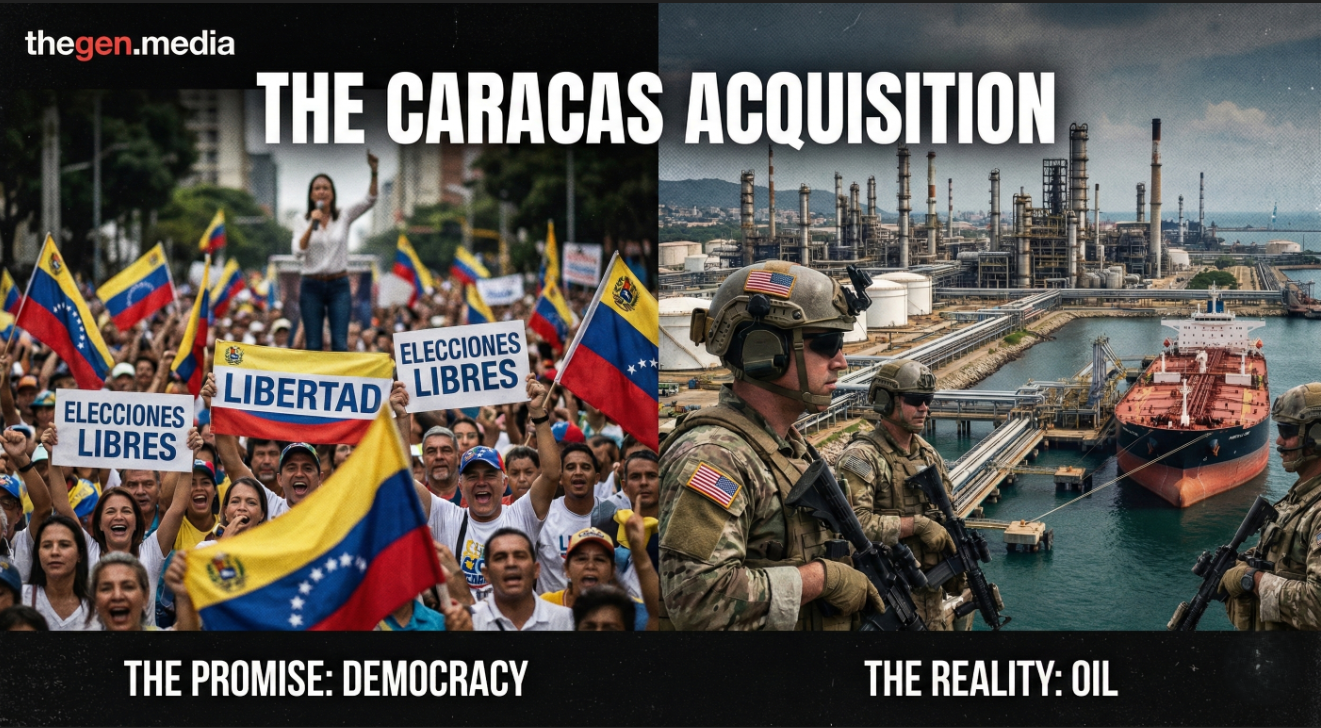
Four days after the US military removed Nicolás Maduro, the democratic opposition remains sidelined. The focus in Washington has shifted entirely from ballots to barrels.
Caracas / Washington D.C. | January 7, 2026
When US Special Forces executed "Operation Absolute Resolve" in the early hours of January 3rd, extracting dictator Nicolás Maduro from Miraflores Palace, the stated mission was clear: the restoration of democracy in Venezuela.
Seventy-two hours later, the narrative has shifted drastically.
The celebratory mood among Venezuela’s diaspora has curdled into confusion. The legally elected leader of the democratic opposition, María Corina Machado—who was expected to assume leadership—has effectively been ghosted by her American liberators.
Instead, Washington is cutting deals with the very military generals who propped up Maduro for a decade, prioritizing "stability" over democratic transition. Simultaneously, declarations from the White House have made it clear that the primary objective is now securing the world’s largest oil reserves.
Here is a breakdown of the facts on the ground, contrasting the "democracy narrative" with the geopolitical reality of the last four days.
The Sidelining of Democracy
The central premise of US intervention was that Maduro was an illegitimate usurper and that power should return to the people’s chosen representatives.
However, since the January 3rd extraction, Machado, who won the opposition primaries with over 90% of the vote, has not been installed as interim President.
Reports from Caracas indicate that US State Department officials are instead forming a "Transitional Military Council," comprised largely of defecting generals from the old regime. The logic is pragmatic: only the military can secure the oil infrastructure in the short term. A civilian transition is messy; a military handover is efficient.
For the millions of Venezuelans who marched for democracy, this looks less like liberation and more like a change of management.
The 300 Billion Barrel Elephant
To understand why the democratic process is being slow-walked, one must look at the geological reality of Venezuela.
The Asset: The Orinoco Belt
- Proven Reserves: 303 Billion Barrels (Largest in the world)
- Comparison: More than Saudi Arabia (267B) and the USA (68B).
- Key Player: Chevron is currently the only US major with operational capacity on the ground.
For years, under Maduro’s mismanagement and crippling US sanctions, production plummeted from 3 million barrels per day to barely 700,000. The infrastructure is rusted, but the oil is still there. The "liberation" has effectively cleared the field for a massive expansion of US corporate energy interests in the region.
"Controlled By Me"
If there was any ambiguity regarding the US administration's priorities, President Trump dispelled it in his press conference yesterday, January 6, 2026.
Addressing the cost of the military operation, the President did not mention elections or human rights. He talked about payment in crude.
"We have done the world a great service. But Venezuela has a tremendous wealth that has been squandered. We are requiring that 50 million barrels be turned over immediately to replenish our Strategic Petroleum Reserve. And the revenue from future sales... that money will be controlled by me, until we know it won't be stolen again."
This statement marks a pivot in modern foreign policy: an explicit acknowledgment that the occupying power will directly control the sovereign resource revenue of the "liberated" nation.
The New Reality
As of this morning, January 7th, US troops are guarding the oil terminals in Puerto La Cruz, not polling stations in Caracas.
The facts suggest a stark conclusion: The US determined that Maduro was an unreliable CEO for the world's largest gas station. He has been removed. But the goal was never to hand the keys over to the Venezuelan people; it was to ensure the pumps remain open for business, under new, American-approved management.