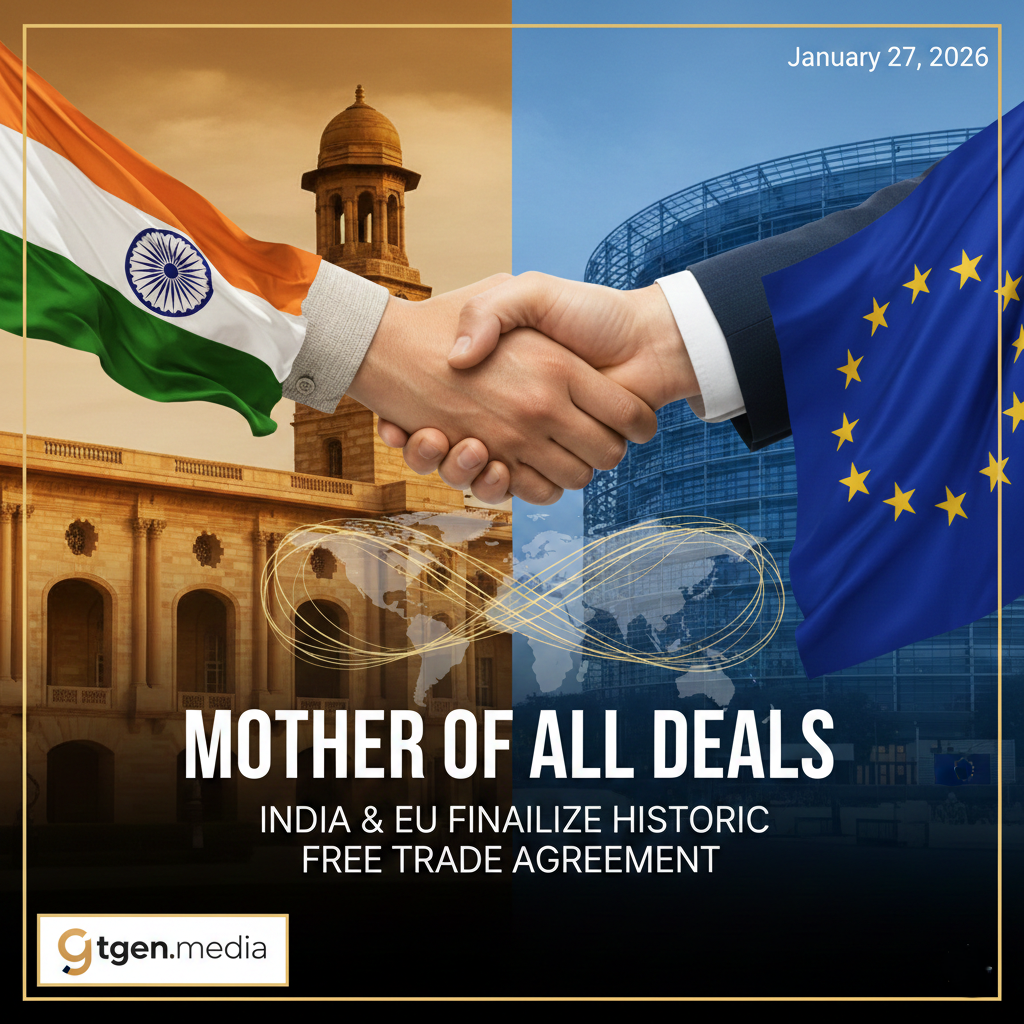
"Mother of All Deals": India and European Union Finalize Historic Free Trade Agreement
NEW DELHI — In a landmark shift for global commerce, India and the European Union officially concluded negotiations for a comprehensive Free Trade Agreement (FTA) on January 27, 2026. The deal, announced at the 16th India-EU Summit at Hyderabad House, creates a free-trade zone encompassing two billion people and a quarter of global GDP.
The agreement, described by both sides as the "mother of all trade deals," will eliminate or reduce tariffs on over 96% of bilateral trade. This comes as a strategic pivot for both economies amid escalating trade tensions with the United States and global economic reorganization.
Key Benefits for Indian Labor-Intensive Sectors
The pact provides a massive boost to India’s export-oriented industries by granting preferential access to 99.5% of Indian trade value. Key highlights include:
Textiles and Apparel: EU tariffs of 12% to 17% will be eliminated immediately, placing Indian exporters on a level playing field with competitors like Bangladesh and Vietnam.
Gems and Jewellery: India has secured zero-duty access for these sectors, which is expected to double trade volumes and reduce dependence on the North American market.
Agriculture: While India successfully protected sensitive sectors like dairy and poultry, it gained duty-free access for shrimp, spices, tea, and coffee.
The EU Gains: Automotive and Luxury Goods
The European Union has secured unprecedented access to India's traditionally protected market, particularly in high-value manufacturing:
Automobiles: India will slash import duties on European cars from 110% to 10% over a phased period. This is governed by a Tariff Rate Quota (TRQ) of 250,000 vehicles annually to protect domestic manufacturers.
Wines and Spirits: Prohibitive tariffs of 150% will be reduced to 40% initially, and eventually to as low as 20% for certain categories.
Industrial Goods: Tariffs will be removed for European machinery, medical devices, and aircraft components, lowering costs for Indian industrial modernization.
A Strategic and Security Partnership
Beyond commerce, the two powers signed a Security and Defence Partnership. This includes a comprehensive mobility framework designed to ease visas for Indian professionals, students, and researchers working in the EU. European Commission President Ursula von der Leyen noted that the deal sends a powerful signal that "rules-based cooperation still delivers great outcomes."
Implementation Timeline
The concluded text is currently undergoing "legal scrubbing" and translation. Following ratification by the European Parliament and the Indian Cabinet, the agreement is expected to be formally implemented by early 2027.